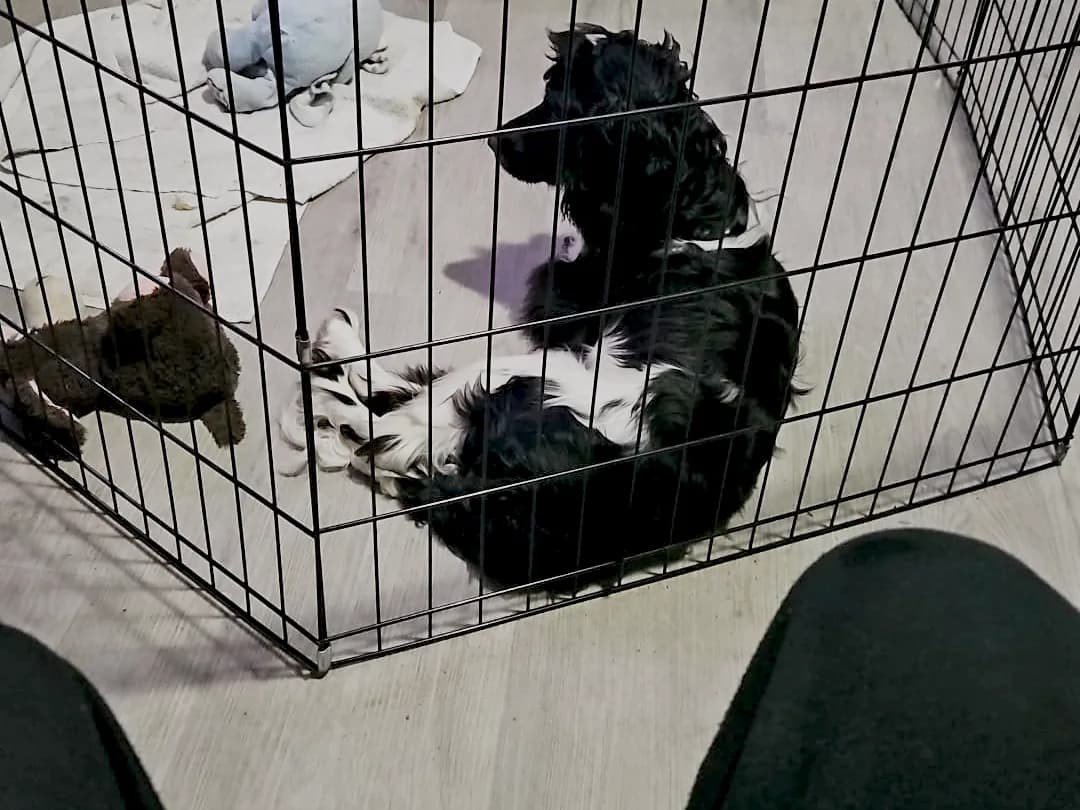
The day Coco came to me was not planned.
On 18 May my mother and a friend of hers went round to his place, because they were worried about how she was doing. The fact that my offer to help with the training had led nowhere played a part in that, but that was a side issue. They did not go there to take her away either, but to talk about how this could best be solved.
He got angry. And then he said: if you can do it better, take her with you.
That was not what that conversation was meant for. But at that moment it was the best option on the table. If we said no, there was a good chance we would never hear anything again, and then we would not know where she would end up either.
So that same evening she was standing inside my house at a quarter to eight. I had deliberately stayed up that night to fix my sleep rhythm, so I had already been awake for about thirty hours. A strange start, looking back, and it did not become an easy week either.
Officially she was not mine yet at that point, by the way. That was only sorted out later, and that story belongs to week 2.
What came through the door
Coco could not lie still. She was permanently busy, bit at everything and settled nowhere. If I so much as put a glass down, she looked up straight away and was switched on again. Outside it was worse. Out there everything came down to pulling on the lead and running circles.
That is the point where most people start with exercises. Sit, walk nicely, wait. But a dog who cannot rest cannot take anything in either. So that is not where I start.
That same glass is also the first place I see something change, by the way. On day three she already reacts less to the sounds I make. Where she used to look up straight away, she now looks for a moment and sleeps on.
What I was working towards
Two things: that she could rest, and that she noticed it was safe here. Nothing more. No commands, no building up, no homework.
When that would happen did not matter. I have never had a goal per week. A next step only comes when Coco is clearly ready for it, not because a schedule says it is time. As long as it keeps getting a little better, you are doing fine.
Often you do not notice yourself how much is changing. Only when you look back a week later do you see that something that did not work then now happens by itself. I really needed that looking back. It gave me the perseverance to keep going, however hard it was.
The resting chair
A few hours after she came in, I put a chair in the middle of the living room and sat down on it. I did nothing. I was on my phone and I did not look at her.
She got calmer and calmer, and in the end she lay down. Not because I asked anything of her, but because I was calm myself. That was the first time that day she lay still.
That chair became the resting chair. If she was in her pen, she cried until I sat down. After that she knew: now we lie down and do nothing.
Only in those first days I really did sit on it the whole time. She could not handle me getting up yet. If I stood up to go to the sofa, she was awake again straight away and went off, and then I simply went back to the chair until she was lying down.
I noticed that it really was about that chair because other places did not work. Not on the sofa, and not on the chair at my computer either, even though she could see me just as well there. If I sat on that one chair, she got calm. So it was not about me, and not about whether she could see me. That chair meant one thing to her: nothing is happening now.
In those first days I did not get off it at all, by the way. Even grabbing a glass of water, just behind me, was already too much.
When that got better, I went over to the sofa very calmly. On day four that worked for the first time without her shooting out of it. If she did hear me walking, she was right there again and it often did not work any more. On day five the chair at my computer was added, and I could sit there while she slept.
That way it became an order instead of one fixed place. First on the resting chair until she was lying down, and only then on to the rest. In the end she only got up now and then to check I was still there, and then lay down again.
Sound in the house
On day two I put music on, and it never went off again that week. The reason was simple: she reacted to small sounds from the neighbours. A door, a voice, something falling. In a terraced house that goes on all day. With music on those sounds stood out less, and she had less to react to.
At first I had calm music with singing on. From the third night I switched to piano only, and that seemed to work better. At that point that was a feeling, not knowledge.
Later I found out that research has been done on this. With dogs in a shelter, classical music turned out to give a lower heart rate, less barking and more lying down instead of standing. That research is on the site of the University of Glasgow.
In that same research the dogs were used to it within a day, and by the end of the week the effect had disappeared. So music is not a button you switch on and forget. Vary it, and use it as a tool to dampen sounds from outside, not as a replacement for rest.
On day four the television was added. I put videos on YouTube on to see what she made of them. Ordinary footage of dogs walking and playing, and alongside that dog cartoons like Bluey. That kind of cartoon is made with the colours dogs can see. First she started wagging her tail in surprise, then she went and lay down with it, and she fell asleep watching. With the cartoons that last part clearly went faster than with real dogs. When I noticed it made her calmer, I started using it more often.
That became a fixed moment in the evening. Not because a dog needs television, but because it was something she could lie calmly next to without anything being asked of her.
The nights
The first night I just lay upstairs in my own bed. That came to about two hours of sleep, because she cried and I kept waking up from it. The next evening I went downstairs and slept on the sofa, so I was nearby. I kept that up for five nights.
That first night felt like one long continuous crying. Whether that was really the case I do not know, because I was not paying attention to the pauses yet. I did not know that meant anything. To me it was just a dog crying and a night that would not end.
If your dog has pauses between the crying, he can still calm himself down. If there are no pauses, he is in real panic and will not get out of it on his own. That is the difference between pushing through and going too far.
I do know that now, and from the second night I started paying attention to it. That is when I saw it too: the silences got longer and the crying in between got shorter. That became my measure. Not whether she cried, but whether the pauses were growing.
After that a bit of sleep was added every night, for both of us. Not better all at once, just a little more each night.
The pen around the crate
After that first night it was clear the crate was not going to work. She had destroyed her cushion and the towels I had used to make it dark.
That was not boredom. At her previous owner the crate was a place of punishment, and you do not go and lie down in a crate like that because you are tired. You stay on your guard instead.
So everything I did after that came down to one thing: making that place a place where nothing happens again.
So a pen had to come, and fast. That became half a day of phoning and asking around. The pet shop had nothing, we asked in a local group whether anybody had one, and in the end it came from an acquaintance who was abroad himself and whose pen was in a locked shed. The key was found that afternoon.
I put that pen around her crate. That meant she did not have to be in the crate, but she could choose it herself. That difference turned out to be big. Meanwhile I slowly made the crate itself nicer: through the day I threw kibble in, and I gave her her food in there too.
How you build that association with a dog who does not trust his crate is in Dog won't go in the crate.
If she wrecked something in that pen, I simply took it out. Without reacting, without saying anything about it and without looking at her. And a little later I gave it back. That way the distraction disappears, she learns that wrecking things gets her nothing, and she also learns that it is not gone for good.
It went faster than I had expected. In the night from day four to five I walked to the toilet and saw her lying asleep in the crate of her own accord, and on day six she took a nap in it during the day for the first time.
Biting got her nothing
Coco bit a lot. At my clothes, at my hands, at anything that came past. That is the one thing I did do something about straight away that week, because the longer it pays off, the more normal it becomes for her.
What I did was simple: the moment she bit, I stopped giving attention and ignored her. No "ouch", no pushing her away, no turning it into a game. I became boring. Only when she stopped was there something to be had again.
Visitors had to ignore her first
From the first evening I asked visitors for the same thing: no eye contact, no stroking, no talking to her. Only once she was calm was she allowed to be greeted. And if she started biting, the visitor had to ignore her just as quickly and become boring too.
I wanted that clear from the start, for two reasons. That way visitors change nothing about what her day looks like, and it stays true: with somebody else as well, biting gets her no attention. One person who actually enjoys it is enough to set your progress back a step.
What I deliberately did not do was send her to her place when visitors came. She did not know that place well enough yet. Something new is happening in the house, and asking for something that is not solid yet at exactly that moment is asking too much.
And I kept the visits small. One person at a time, and no more than once or twice a week.
My mother came over to look after her a few times that week, because I was sleeping so little that I would not have kept it up otherwise. The first time was already on day two.
That afternoon something went wrong that shows exactly what it is about. I was upstairs asleep and heard Coco crying downstairs. My mother's partner had left and Coco reacted to that. My mother did what almost everybody does: shushing, saying sstt, reassuring her.
I texted her from bed that she should not do that. No sstt, just sit down on the chair, no eye contact, say nothing.
That helped straight away. Coco got calmer, after that they spent another quarter of an hour outside practising walking calmly beside her, and inside Coco went and lay down in the pen of her own accord.
Shushing sounds kind, but for a dog who is already tense it confirms that something is going on. You react, so there was apparently something to react to. Doing nothing on that chair said the opposite.
How you have visitors over without your dog going over the top is coming in a separate explanation about visitors. It is not there yet.
The cat went upstairs
My cat Mowgli was already living here before Coco arrived. He had known dogs for years, and he had seen Coco a few times before she moved in, back when she was not this tense. But this version of her was simply too busy for him.
His solution was as practical as it was clear: he went upstairs and stayed there. That lasted a while. In that period I also gave him his food upstairs. I did not want to force him to come down. He could do that in his own time, at the moment he was ready for it.
That is exactly why I never let Coco go upstairs. Upstairs was not an option, and it never became one either. I wanted Mowgli to have a place Coco did not come. And once I was sleeping in my own bed again, that stayed the moment for my cat and me.
The first real contact came on day five, and he started it himself. I was walking past the stairs and saw Coco going up a few steps to look. I was about to call her back, but Mowgli came further down instead. They went nose to nose and he rubbed his head against her. Coco kept her back legs on the floor and held herself in, while you could see how hard she found that.
Two things kept her there. She knew she was not allowed up the stairs, so she did not go further than those few steps. And she had learned from me that getting too busy means it stops, so she held herself in to let it carry on.
And the moment I was upstairs in bed, Mowgli asked for more attention than he normally did. He even woke me up several times at night, and he never used to do that. Normally he just stayed lying down until I got up myself.
That makes sense too, because upstairs was the only moment of the day he had me to himself again. Before that he was with me all day. I really did feel guilty about that at the time: one of them finally got rest and the other lost something. In the end it came good completely. Animals feel it when the house gets calmer, and then a cat like that comes over to say hello again by himself. How that went you read in the weeks after this one.
How you let a dog and a cat get used to each other is coming in a separate explanation. It is not there yet.
Outside every hour
She was not house-trained yet, and she could not hold her pee for long either.
So we went outside every hour, always to exactly the same patch of grass. That patch is literally right around my house. I live in a terraced house and it is two houses along. So it was not even a walk.
And that every hour stayed that way for about two more months. Only after that could she hold it for two to three hours.
And even though that was only about twenty-five seconds of walking, it was already too much. The moment we got into the hallway she pulled at the coats, and outside she ran circles and wound herself right up. The outside world was simply too many things at once: so much was happening that she had no idea what to do with it.
That is also exactly why I kept it so close by. After a few minutes she was spent again.
The order was always the same. First a pee, in the same spot, so she knew what was expected of her. Only after that did we walk a little way to the part of the patch that is closer to the road, and there she was allowed to just look. At cars, at people, at whatever came past. But always briefly.
And only if I noticed she could handle it. If I saw her starting to wind up, we went straight back inside and I skipped that bit. We never did anything she could not handle at that moment. Better a minute too early inside than a minute too late, because too late costs you the rest of the day.
Looking was always allowed, I never wanted to train that out of her. It was about what happened after that. I waited until she brought her attention back to me, and if that did not come by itself I helped her a little bit.
I never called out to her. I whispered or made a soft little noise, because I wanted to come across as calm as possible myself. If she then looked at me, I said "good" straight away and gave her something. I always used that word in the same way: it means this was the right moment and that something is coming.
After a while I did not have to do anything any more. Then she saw something and looked at me of her own accord, and that is what I rewarded hardest of all.
I only built "good" up as a fixed marker word later on. If I had had it earlier, this would have gone faster. If your dog already knows a word like that, all you have to do is say it the moment he sees something. He looks at you, you reward, and you repeat that until he looks at you of his own accord as soon as he sees the trigger.
How you build up a marker like that, and when your voice does exactly the same thing as a clicker, is in Clicker training for your dog.
And that is how the days got their rhythm. Doing nothing on the chair, quickly outside, doing nothing on the chair again.
What I did do in between
I say that week was not about training, and that is true. But it is not that I taught her nothing at all. There were small things in there, and they all had to do with rest or with being outside.
On day six I attached a word to that looking at me: focus. That was only possible once she already knew the behaviour. Indoors I also practised it separately. I held a treat next to my face, so that she kept looking at it. And then I did nothing. Only the moment she looked at me of her own accord instead of at the treat did I reward her. That same day it already helped outside, with a parked car she found scarier than a moving one, and with somebody she had already started barking at. I said focus, she looked, and after that she let it go.
How you build up focus and what you do when it stops getting through is in My dog ignores me.
Indoors I stretched out the sit. At first she walked off straight away as soon as she had her treat. I taught her that a sit keeps holding until I say "free", and within a few days she sat still for thirty seconds.
And I used "no" as a correction. Not angry, just a word that means: not this. I say it once, and the consequence follows right after it: I take her away from what she is doing, or I interrupt it. That second part is the most important, because without a consequence it is only a sound that you end up repeating louder and louder.
To be honest, that word did not come about deliberately with me. I said "uh uh" and I said "no", simply because that is what came out, and that is how I built up two of them that both mean the same thing. If I were starting again, I would pick one in advance and stick to it. These days I mostly lean on "Coco, no".
By the end of the week she not only stopped at it, but she sometimes also held herself back before I had to say anything.
Feel free to call it training, because that is what it is. It is just that for me training is not a session you set aside half an hour for. A good session does not last longer than about ten minutes anyway, and in this week it did not even come to that. It was in the moments that were there already.
Treats: from rabbit ear back to kibble
Outside she only wanted rabbit ear at first. Ordinary kibble and ordinary treats she spat out, because everything around her was more interesting. I broke those rabbit ears into small pieces, so one ear lasted a whole walk.
Still it was a bit too much of the same thing, and it upset her stomach. After that I started using it more deliberately: rabbit ear for the moments she still found really hard, and for the rest just her own kibble or a normal treat.
The strange thing was that this got easier as well. The less exciting the outside world became, the tastier her ordinary kibble was. Not because the food changed, but because the competition got less.
The day I messed it up
Halfway through the week a friend came over. We walked a stretch, and on the way we came across dogs. I knew she was already tired. I should not have walked further than the patch of grass.
I did not listen to my own feeling. Not because I did not know, but because somebody else suggested walking that way, and because part of me wanted to as well.
And that is exactly what you should not do. It is not about what you want, it is about what your dog can handle at that moment. Look at that, and decide on the basis of it.
So do not go along with other people because you do not want to say no or do not want to come across as rude. If somebody asks whether their dog can play with yours and you know it is not going to work, just say no in a friendly way. And if you notice during the play that your dog is at his limit, cut it off. Do not wait until it is too late.
For the rest of that day she did not settle again. She wrecked the rug in her crate, she did not sleep, she did not pee and she did not poo. And I was done in myself at that point. That evening I could not take it any more.
What struck me about that: the more tired I got myself, the harder I found it to stay calm. And she has enough to go on with me to notice that something is up. Sometimes you are so spent that what you want most is to shout something angrily. That is human, and I think everybody knows it. But it is exactly what you should not do, because she understands none of it and the only thing she takes from it is that I am unpredictable.
So at those moments I chose to take some distance. Another room for a bit, nothing for a bit, instead of carrying on while I was not really there any more.
A dog who has to recover asks more of you than you think, and your own tiredness is part of the story. When I got too tired, I made mistakes and reacted too late. Make sure there is somebody who can take over for a couple of hours, and ask for that before you are spent instead of after. And if you notice that you cannot stay calm yourself any more, take some distance instead of reacting angrily. That is not giving up, that is preventing your dog from getting your tension on top of it all.
Where we stood at the end of the week
Sounds could still startle her. The difference was that she recovered from them faster and faster.
On day seven I slept a whole night upstairs again for the first time. She did still cry, but every night she calmed down a bit quicker, and in the end she slept through. Finally a night's sleep again, for both of us. And what I had not expected: she actually slept through longer now that I was no longer lying next to her.
That probably comes down to the fact that she could not see me any more. If I was on the sofa, she looked up now and then between sleeping, saw me, and was reminded again that she wanted to come to me. If I was not there, there was nothing to check either.
What I take from it
That first week was not about what she could do, but about whether she settled. What I taught her in between was small and short, and it was always in service of that rest or of the things she still found hard. Focus made outside easier. Stretching out the sit made waiting easier. No building up, no homework, no goal to hit.
That is exactly what made everything that came after it possible.