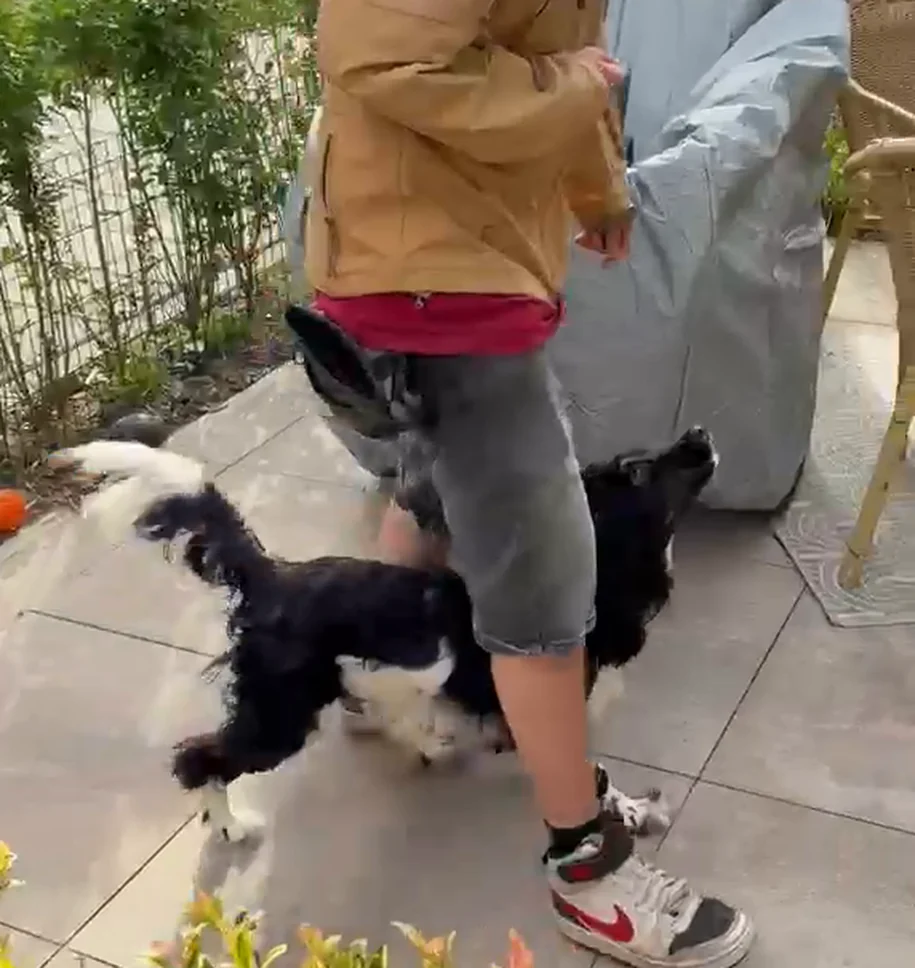
Most people think of training as a slot you set aside for it. Half an hour in the garden, a list of exercises, and then it is done.
That is not how it works for me. I train in two ways, and each has a different purpose.
One is a real session, where you teach your dog something new. For me that lasts about ten minutes. The others are the moments spread through the day, and those last a few seconds.
Just as much gets learned in those short moments. Sometimes you use something your dog already knows, exactly at the moment it matters. And sometimes you teach something new that needs no session at all. "No", for example, or "drop it". Those are words you can only practise at the moment they come up: when your dog is holding something he needs to let go of, or when he does something he should not.
The session: about ten minutes, and stopping sooner is fine
A session is where you teach something new. Sit, down, paw, walking in heel, that sort of thing. With walking in heel you start indoors, before you try it outside on a walk.
For me ten minutes is the upper limit, not a target. If I notice her attention dropping away, I stop sooner. For most dogs ten minutes is long enough, and for a puppy longer is nearly always too much. There are dogs who can handle more, and that is fine, but you read that off your dog and not off the clock.
Never stop at the moment it goes wrong. Ask for one more command your dog finds easy, reward that, and leave it there. Then he remembers the session as something that went well, and he comes into the next one differently.
How you can tell your dog has had enough
Your dog tells you himself, and usually sooner than you think. This is what I watch for:
- He gets frustrated faster: he gets too wound up, or he starts biting.
- A command he normally knows perfectly suddenly does not work any more.
- He is distracted by everything. Every little thing in the house or in the spot where you are training becomes more interesting than you.
If you see that, there is nothing more to be learned. If you carry on anyway, you both get frustrated because it is not working, and nobody is better off for that.
Next time, look at what your dog does just before he checks out. That is where your limit is. Stop there, and stop on a command that goes well.
The short moments through the day
This is the part most people skip, and it is also the part that gives you the most.
Any situation can become a training moment. Not because you plan anything for it, but because something is happening anyway that you can use.
An example from my own hallway. If your dog is worked up there, have him sit. If he stands up, you help him back into the sit, without saying anything else about it. If he holds it for a while, a treat can follow. For me that went like this: I put on one shoe and rewarded her for staying in the sit. Only then the second shoe, and rewarded again. If she stood up, no reward came and I helped her back.
If the sit does not work because at that moment your dog does not even hear you, you need something else first.
On a walk I do it more or less constantly. I have her stop or sit for a moment while we walk side by side, I ask for a different position, or I do a bit of find it or catch. Those are all small things, and they make the walk more fun for her too.
That matters more than it sounds. If your dog knows the two of you are going to do something together along the way, he also pays more attention to you. You see him staying closer, and at some point he starts doing things on his own that you never asked for, like coming to walk neatly beside you.
I do not count those moments. How many there are in a day simply depends on what happens.
If your dog does something wrong, turn it into a lesson
If your dog does something he should not, that is not an interruption of the training. That is the training.
If he puts his front paws up against the table or against someone, say the word you want to use for that first. For me that is "off". And then help him down.
After a number of times he knows what is coming. Then all you have to say is "off". And in the end he works out for himself that it is not wanted.
I did the same with "no". For me that is not angry, it is just a word that means: not this. I say it once, and after that the same thing always follows: I take her out of the situation.
I used that a lot with my cat. If Coco went after Mowgli, I said "Coco, no" and took her away. At some point the word was enough. Then she stopped, looked at the cat for a moment, sighed, and walked back to her spot.
To be fair: that happened gradually, and I was not always consistent myself. That I started saying the word beforehand instead of only while taking her away was really an accident on my part. Only afterwards did I see that this was exactly what made the difference, because at some point she stopped at "Coco, no" alone. I no longer had to get up to take her away.
And after that it went a step further. She started reading the cat's reaction herself. If he meowed, she already knew I was going to say "Coco, no", and then she stopped before I had said anything. At that point she did not need the word any more.
Say the word first, except when you teach your dog a trick
There is a difference here that I only properly understood later, and it is the most important thing in this whole explainer.
With something that comes back every day you say the word beforehand. "Off" before you help him down. "No" before you take her away. That works, because what follows is always the same and you carry it out yourself. Your dog does not have to guess anything.
With a trick that does not work. Sit, heel, paw: there your dog first has to understand what you want from him before the word can mean anything. If you say it too early, you are attaching a word to a moment where he is not doing anything right yet.
So with a trick you say the word afterwards. Your dog sits down, and only at that moment do you say "sit", so he hears the right reaction being named. You also hear "good sit" used for that, instead of "sit" beforehand.
Once it goes smoothly, you move the word to the front. You say "sit" and you wait a few seconds. If nothing happens, you help him after all, and then you say the word once more. That is the phase where you give your dog the chance to do it himself and only help when it is needed. Until the penny drops and he does it as soon as you say it.
You can teach both without a problem, but do not do them at the same moment. Say your command first, and only then make your hand signal. If you do them together, your dog mostly watches your hand and ignores your voice. And then it stops working as soon as he is not looking at you. I am in favour of adding a hand signal: that way you can still ask for something when he cannot hear you, or if he goes deaf later in his life.
The mistake almost every dog owner makes
Repeating the command.
Do not do that, not even during training. Always say the word only once. While you are teaching it too, and also when he does not do it afterwards. Wait a moment, then help him, and say the command once more after that so he makes the link. But never again beforehand.
That counts most with the recall. You want your dog to come the first time you call, not the third or fourth. And every time you repeat yourself, that first time is worth less.
Does your dog always need a treat?
At the start, yes. With something new you want to make clear to your dog when he gets it right, and a treat is the easiest means for that.
Just pay close attention to what you are rewarding, because that goes wrong faster than you think.
Say your dog pulls ahead on the lead and you bring him back beside you. Do not reward that straight away. Wait until he really walks a few steps neatly beside you. If you do it immediately, you can easily end up rewarding the whole loop: pulling ahead and coming back again. Then he starts pulling all the more, because apparently that pays off.
And look not only at what you are rewarding, but also at how hard it was for your dog at that moment. If he comes back to you while he actually wanted to run at another dog, that is not an ordinary moment. That is a choice that really cost him something, so you can reward it far more heavily.
At a moment like that, give several treats one after another instead of one. Not a handful at once, but treat after treat. That does two things: he makes that choice faster next time, and he stays standing with you instead of shooting off after that single treat to do what he had in mind anyway.
Start with what you and your dog really need
Paw and a spin are fun, but they solve nothing. Sit does not belong in that group, by the way, because you use it all day for impulse control: a short sit before anything is allowed.
Always start with the basics, and with the commands you really use in daily life. The recall. "No". Focus, to make being outside easier. Alongside that, start on impulse control right away: waiting at the door, and waiting at mealtimes. That last one is something most dogs pick up fairly quickly.
How much difference there is between a puppy, an adult dog and a dog with a history really depends on the dog. With Coco I first had to sort out something very basic: as soon as she had her treat, she walked off. For her that treat meant it was over. I had to teach her that a sit stays in force until I say "free". A dog who keeps contact on his own does not need that step at all.
What it comes down to
One session of ten minutes at most to learn something new, stopping sooner when the attention drops away, and always ending on something that works.
The rest of the day, short moments of a few seconds, at the moments that come up anyway.
The word beforehand for everything that comes back every day, and afterwards for a trick, until it goes smoothly.
And it costs you no extra time. Your dog has to go out anyway, and you do those things anyway.
Frequently asked questions
At what age can you start training a puppy?
As early as possible.
What often goes wrong is that people think a puppy is still too young to learn anything and wait until he is a bit older. A puppy of eight weeks can learn perfectly well already. And putting it off does not mean he learns nothing, it means he learns things you do not want.
Pulling on the lead is the clearest example of that. If you walk along when he pulls, you are teaching him to pull, and later you have to get that out of him again. If you teach him to walk beside you right away, he never learns to pull in the first place.
How long should you train your puppy each day?
Shorter than with an adult dog.
Ten minutes is the upper limit for a real session, and for a puppy that is often already too long. Stop as soon as you see his attention dropping away, and always end on something he finds easy.
On top of that, all the short moments through the day simply count. Those last a few seconds and a puppy learns just as well from them.
How long does it take before a dog knows a command?
That differs per dog, and above all per breed.
Stanley Coren is a Canadian psychologist who asked hundreds of obedience competition judges how quickly different breeds pick up a new command. That became his book The Intelligence of Dogs, and the differences in it are large.
With the breeds at the top of that list, like the border collie, the poodle, the German shepherd and the golden retriever, a new command is often in place within five repetitions. On average it is around 25 to 40 repetitions. With the breeds at the bottom, like the basset hound, the chow chow and the Afghan hound, it is 80 to 100 or more.
That says nothing about how clever your dog is in daily life, and certainly nothing about how nice he is to live with. It only says something about how quickly he picks up a trained command.
What you see yourself matters more. If he only does it after you wait and help him, he is still learning. If he does it as soon as you say the word, and in another place too, then he knows it.
How many commands can a dog learn?
Far more than most people ever try.
That same Coren arrives at about 165 words and gestures for an average dog, and around 250 for the smartest twenty percent. He compares that to a two-year-old child, as NBC News recorded it at the time.
The extreme is border collie Chaser, who could fetch 1,022 toys by name.
You do not have to work towards that. Mostly it shows that the number is rarely your limit. Consistency is: ten commands that always mean the same thing are worth more than thirty that are sometimes followed and sometimes not.
Why does my dog listen indoors but not outside?
Because at that moment outside is worth more than you are.
You do not solve that by calling louder or saying it more often. You have two dials: you become more fun, and the environment becomes more boring and more predictable.
You make it more boring by starting in places he already knows, and only moving on when it really goes well there. You become more fun by being someone there is something to be had from, instead of the person pulling on the other end of the lead.
Do you teach your dog a hand signal or a spoken command first?
Either is fine, as long as you do not do them at the same moment.
I do teach them alongside each other, but not simultaneously. First I say the word, and only a second or two later comes the hand signal.
If you do them at exactly the same time, your dog looks at your hand and no longer hears your voice. And then it does not work at the moment he is not looking at you, or when your hands are full.
Adding a hand signal is worth it, though. You can then still ask for something when he cannot hear you, or if his hearing gets worse later in his life.