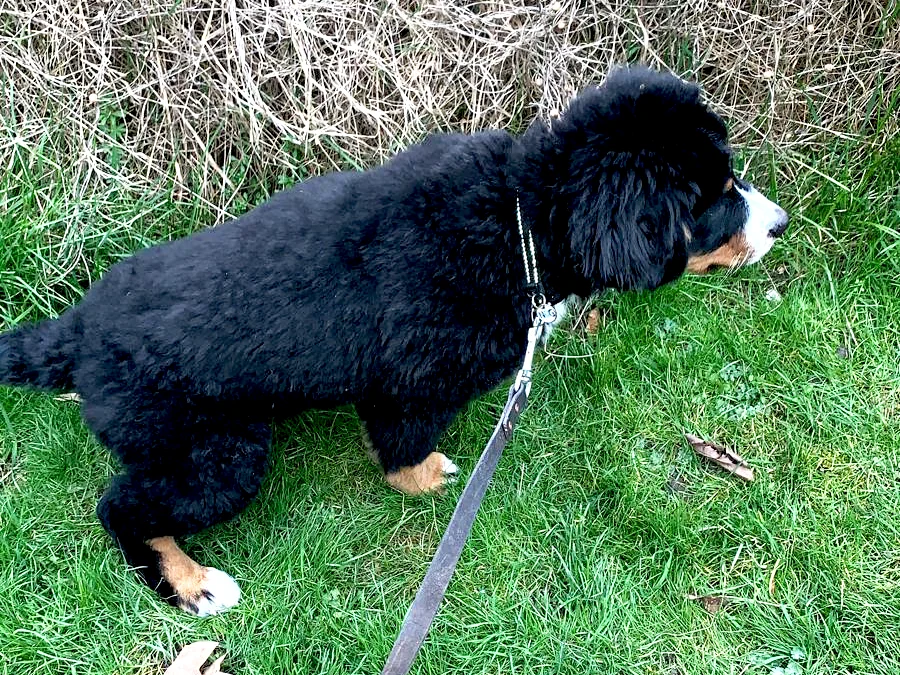
House training a puppy is not training you give him. It is mostly you looking ahead: having him outside before he needs to go, and not after it has already happened. His bladder does the rest by itself, because it is still growing.
That also means almost every accident indoors is not his fault. Someone was not paying attention for a moment, or missed the signal. There is nothing to do about that except see it sooner next time.
His bladder still has to grow
A puppy simply cannot hold it for long yet. The AKC uses roughly one hour per month of age as a rule of thumb, and that keeps going until about nine months. So a three month old puppy manages around three hours, and that is a ceiling and not a target.
In the first weeks you just go outside every hour. That is more often than strictly needed, and that is exactly the point: every time he goes outside is a successful repetition. Every time it happens indoors is one you do not want. You win this with numbers.
Every hour, and after every moment
Besides that hour there are moments when it is almost certain. After waking up, after eating and drinking, after playing, and after he has spent a while in his crate.
Those moments do not stand apart from the rest of his day. A puppy with a fixed rhythm is a lot easier to house train, simply because you then know when what is coming.
Watch the way he walks
This is the part almost nobody looks at, and it is the most useful thing I can give you.
In a puppy, sniffing the floor and circling are the known signals. Only a young puppy often shows nothing at all, and then you are already too late. So do not only watch what he does, watch how he walks.
A puppy who needs to go walks differently. Wide legged, with his back end sitting just a little differently under him, a bit as though his trousers are full. It looks like a toddler who has only just learned to walk. Once you have seen it a few times, you spot it from across the room.
That is usually your earliest signal, earlier even than the sniffing. And when you see it: do not stop to wonder whether you read it right, just go outside.
Always the same spot
Pick one spot, a fixed patch of grass for example, and go there every time. He will start to recognise it as the place where he goes, and that makes it a lot easier for him.
Do not make a moment of it yourself either. No playing, no talking much, just that calm "good boy" when it has worked. If he gets completely distracted, bring him back to it for a second, but otherwise keep it as boring as you can. It is exactly because there is nothing to be had on that patch of grass that he gets on with what you came for.
Only start the walk once he has been there. If nothing comes after five minutes, do not go for the walk anyway, but take him inside and put him in his crate. Ten minutes later you try again.
Walk him anyway while he has done nothing, and he learns something you do not want: not going gets me a walk. Then he will hold it on purpose, including at moments when you had no intention of walking at all. That way the spot stays connected to going to the toilet and not to hanging around.
Reward at the moment itself
He says nothing and simply gets on with it, so you say a calm "good boy" and give him something nice straight away. Not once you are back indoors, because then you are rewarding walking back in.
Reward within two seconds of the last drop. Wait until he is finished, turns around and comes over to you, and you are rewarding him coming over. That is a fine behaviour too, but it is not what you are teaching right now.
Do not let him go in the garden
This is the mistake I see most often, and it is the one that is hardest to undo later. It comes in two forms, and each one costs you something different.
The garden door stands open. He walks out whenever it suits him, so he never has to tell you he needs to go and he never has to hold it for a moment either. Both are things he would be learning in exactly these weeks, and this way he does not. You notice that on the day that door is shut, or when you are somewhere else.
Or you let him out there quickly. It is raining, or you are tired, and the garden door is simply closer than the front door. It works, so you do it again next time. What he learns in the meantime is that the garden is the place. You run into that the moment you start walking him: he does nothing outside, holds it for the whole walk, and heads into the garden as soon as you get home. That is not stubbornness, he simply learned it that way.
And he does not grow out of it. An adult dog who learned that it belongs in the garden keeps doing it. Undoing that costs you far more effort than getting it right now.
An accident is usually a missed signal
If you catch him while he is doing it, interrupt him with a sound, not with your voice as punishment. Just something that makes him stop for a second, and then straight outside.
If it has already happened, take him outside anyway. Probably nothing will come, but you keep making the same connection.
Do not get angry about it. Not because that would be unkind, but because it does not work: he does not make the connection you mean, and what he does learn is that going where you can see him is dangerous. Then he will do it behind the sofa.
Clean it up with an enzyme cleaner. Ordinary cleaning products take the smell away for you but not for him, and a spot that still smells is an invitation to use it again.
Keep him with you while he is awake
As long as your puppy is awake, you want to be able to see him. Not so you can catch him at it, but so you can be ahead of him: with the toilet, and just as much when he picks up something dangerous or starts wrecking part of your house.
A puppy who walks around the house on his own while awake is practising exactly what you do not want. That is the second mistake I see a lot, and together with the garden it is why house training takes three weeks for one person and three months for the next.
If you cannot watch him for a moment, put him in his crate or behind a gate, or take him with you into the room you are in.
The night
The night often goes better than people expect. A puppy who sleeps in his crate usually holds it there, simply because he does not want to lie where he has just been.
Do count on him finding that crate stupid at first and crying in it. That comes with the territory and it passes, and after that it becomes his own place.
Pee pads and indoor mats
I am not a fan. You teach your puppy that going indoors is allowed in one place, while later that is exactly what you do not want. So you are teaching something you then have to unteach, and that is the same trap as the garden.
Rather go outside a bit more often, even though that is harder. Then you are practising the right thing straight away.
If you live in a flat and going outside every single time really is not doable, use something that looks like real grass. Then the step to outside is a lot smaller later than it is from a mat or a newspaper.
If it stays noticeably often
If he has to go very often despite all of this, or a little keeps coming, have him checked over. In a puppy both worms and a bladder infection are common, and you cannot train your way past those.
Also watch how often he has to poo. Three or four times a day or more, or in the middle of the night, and there is a fair chance his food does not suit him. Whatever is not digested has to come out again, after all.
Frequently asked questions
How long does it take for a puppy to be house trained?
There is no number that is true for your dog. The figures you come across vary as well: the AKC holds that a puppy is usually reliable around six months if you start early, while other sources name four to six months and sometimes up to a year. Some puppies have it worked out in a few weeks.
A spread like that mostly tells you that every dog goes at his own pace, just like every child. What counts is where you end up, not how long you took to get there. A puppy who needs five months is not a failed puppy.
If it does take far longer than you expected, do not train harder but go and look for what is wrong. The physical side first, and after that the basics underneath: does he have a fixed rhythm, does he get enough rest, and can you really keep an eye on him while he is awake.
Why does my puppy pee indoors when he has just been outside?
Watch the moment he stops. A puppy who sees or hears something while he is going simply stops, and then he is not empty yet.
If you saw that happen, go out again shortly afterwards to be sure. Do not stand around waiting for a second helping, because that toilet moment is exactly what you keep short.
If it happens indoors anyway, do not get angry about it. Take him outside to show him where it does belong, and clean it up afterwards.
If it keeps happening very often, it is not a matter of more practice. Then have him checked over.
Why does my puppy not go outside but go indoors straight away?
Usually that is distraction. There is so much to see outside that he forgets what he was standing there for, and once it is quiet indoors it comes anyway.
So do not wait too long before trying again. Inside, let it settle for a few minutes, and out again.
And do not stand around outside endlessly either. It is exactly by keeping it short that he learns there is nothing to be had out there at that moment except going to the toilet.
How do I teach my puppy to tell me he needs to go out?
That telling you only comes once he has worked out that it belongs outside. In the weeks before that he shows it in another way: he sniffs, he walks differently, he gets restless. That is the stage where you are the one who sees it coming, not him.
After that you see it turn. The first thing a puppy usually does is sit by the door you go out of, or head into the hallway already. Watch for it, because it is easy to miss.
Sometimes it looks completely different. He starts being a bit annoying, and it seems like he is winding you up. Usually he just wants to tell you something and does not know yet how to do that politely.
Can I teach my dog to press a bell when he wants to go out?
That can certainly work. Do watch that it does not get abused: some dogs enjoy being outside so much that they press the bell to go and hang about out there.
So you keep that toilet break outside boring. You go out to go, and then back in. The bell does not mean a walk, the bell means a boring toilet break.
How you teach him that step by step is coming in a separate explanation about the bell on the door. It is not there yet.
Why does my puppy pee when he is happy or startled?
That happens more in puppies than in adult dogs, and it is normal. A puppy who is happy or gets a fright simply cannot hold it at that moment.
So it does not mean he is not house trained, and it is not something to say anything about. He cannot help it.
Why does my puppy pee indoors again after a few good weeks?
Do not start over, but first look at what has changed. Has the schedule shifted, is he more restless in the house, has something happened, did you switch food or is he drinking more than before? Those are all things that bring the accidents back.
If you cannot work out what it is, have him checked over. A bladder infection often starts exactly like this: it was going well and suddenly it is not.
Have you just switched food? How you do that calmly is coming in a separate explanation. It is not there yet.
How do I keep it consistent when someone else looks after my puppy?
Give them your schedule, and add what you notice about your own puppy. How he walks when he needs to go, for example, because somebody else does not watch for that by themselves.
Send something along that smells of home too, a cuddly toy or a toy. And if you can, take his crate or his mat. That is not about the smell: it makes his sleeping place clear straight away over there. A puppy who sleeps fine at home may not manage that somewhere else at all, and with his own bed there he understands much faster what is expected.
And the most important thing: only leave him with someone you trust and who really wants to keep to your way of doing it. One person who does open the garden door because it is easier undoes weeks of work.